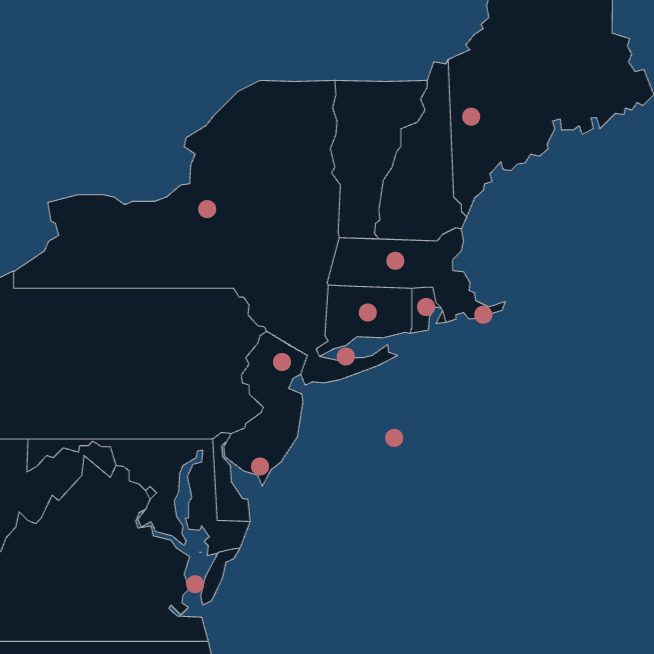

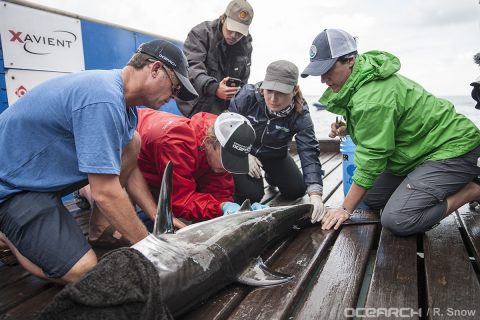
No summer would be complete without sharks making their way into the nightly news. In the past, these headlines primarily came from places such as Florida, California and Australia. In 2012, that changed when OCEARCH’s Expedition Cape Cod sailed into the northeast with the hopes of tagging the adult white sharks that had been returning in greater numbers to the area. This mission was extremely successful, launching several individual white sharks into stardom.
Founded by Chris Fischer in 2009, OCEARCH is a non-profit organization with a global reach for unprecedented research on great white sharks and other large apex predators. To date they have completed 25 expeditions, around the world, tagging adult white sharks, makos, blues, tigers and hammerheads. As a collaborative effort, each of these expeditions is accompanied by researchers from various institutions.
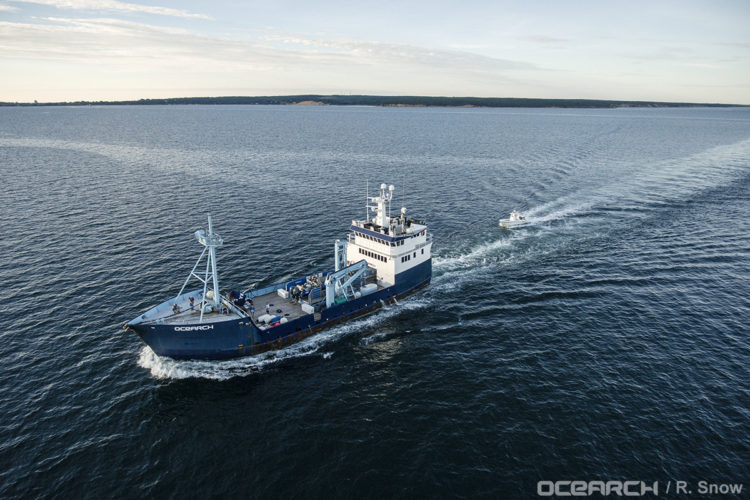
In 2012 and 2013, OCEARCH teamed up with Dr. Greg Skomal of the Massachusetts Division of Marine Fisheries, who has been successfully tagging and tracking white sharks residing in the waters off of Cape Cod since 2009. To deploy their tags, Dr. Skomal and his team first locate a shark with the use of a spotter plane. Researchers then slowly approach the shark by boat, getting within range to deploy a tag with the use of a harpoon. This technique has proven to be very successful, as Dr. Skomal has tagged dozens of adult and subadult white sharks.
OCEARCH’s goal was an ambitious one, to capture, tag, and release adult white sharks; a first for the white sharks of the Atlantic. This method would allow researchers to tag the shark and to collect more accurate data such as length, girth, and weight. Additional samples could also be collected from the shark. A fin clipping can be used for DNA work, while drawing blood allows researchers to better understand their physiology.
This collaboration off Cape Cod was a success, as OCEARCH tagged four adult white sharks. Of the four sharks tagged over the two expeditions, two have made quite the names for themselves. Mary Lee and Katharine were visiting many popular beaches along the east coast. As they did, their fame grew and today they have over 140K Twitter followers between the two of them.
This summer, OCEARCH set out on its 26th expedition, this time in waters of New York. Instead of targeting large, adult white sharks, the team would be focusing on young of the year (YOY) sharks. I joined OCEARCH for three days during Expedition New York, and had an incredible experience aiding in the research on these tiny great whites.
In the 1960s, NOAA biologist Jack Casey began documenting the occurrence of baby white sharks in the New York Bight, and those findings were reported in a research paper published in 1985 (Casey and Pratt 1985). A more recent research paper published in PLOS One (Curtis et. al. 2014) compiled catch and sightings data of white sharks in the Western Atlantic Ocean over a period of two-hundred and ten years (1800-2010), including the records of Casey and Pratt. The data in the paper showed that the New York Bight has a higher density of YOY white sharks than any other area in the NW Atlantic. Another clue to New York’s importance to white sharks was a YOY that was caught and tagged with a satellite pop-off tag by Capt. Greg Metzger and the Long Island Shark Collaboration (@LISharks) last summer in the water off of Southampton. This was the first YOY white shark to receive such a tag in the Atlantic Ocean.

These recent findings eventually caught the attention of OCEARCH, and Expedition New York was scheduled. As with all their previous expeditions, OCEARCH teamed up with local scientists for Expedition NY. The team consisted of Tobey Curtis, shark researcher and fisheries manager at NOAA Fisheries, Wildlife Conservation Society/New York Aquarium, Long Island Shark Collaboration, Florida Atlantic University, New Jersey Institute of Technology, and Stony Brook University. The mission of this expedition was not only to attempt to tag YOY white sharks, but to also tag and collect data on any of the other potential 26 species of sharks that can be found in the waters of New York.
The expedition commenced on August 11th and was met with rough ocean conditions for the first several days, forcing the team to stay on the north side of Montauk Point. Fishing was very slow, with the team only catching smooth dogfish (aka sand shark). Once the seas calmed, the M/V OCEARCH was able to relocate to the south side of the point and set up in more “sharky” waters. The next couple of days continued to be slow, but the team did manage to catch and tag two dusky sharks with acoustic tags (a first for a dusky shark in the Atlantic).
After a week of very little action, late in the day on August 19th, the team finally hooked into a YOY white shark. There was much excitement among the team as this was about to be a historic moment in the field of white shark research. The shark was caught by the crew fishing aboard the 32-foot Contender (one of two support vessels of the M/V OCEARCH). Just as the OCEARCH team had done numerous times before (only with much larger sharks), they slowly motored the shark back to the the mother ship and guided her onto the lift platform.
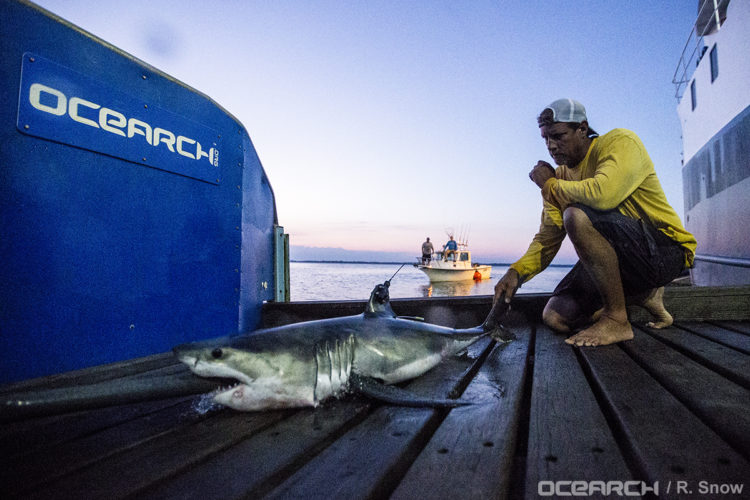
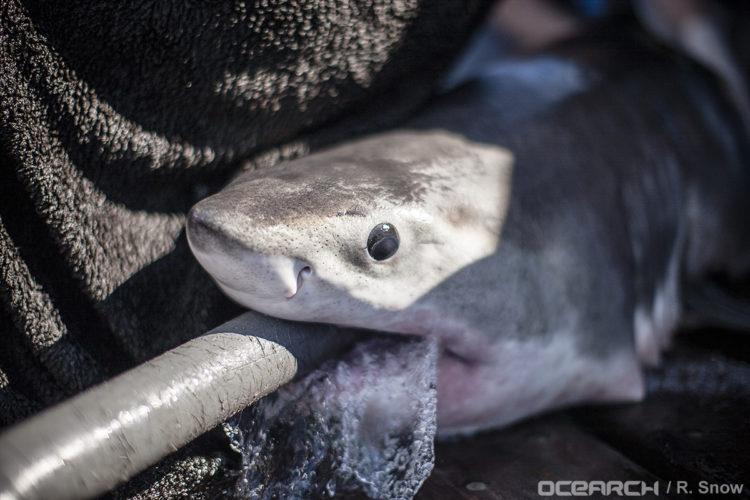
Once the shark was in the lift, it was raised from the water and Capt. Brett McBride quickly inserted a hose into the shark’s mouth in order to keep a constant flow of fresh seawater going over the gills of the shark. A wet towel was then placed over the shark’s eyes in order to keep the shark calm for its own safety and for the safety of the research team.
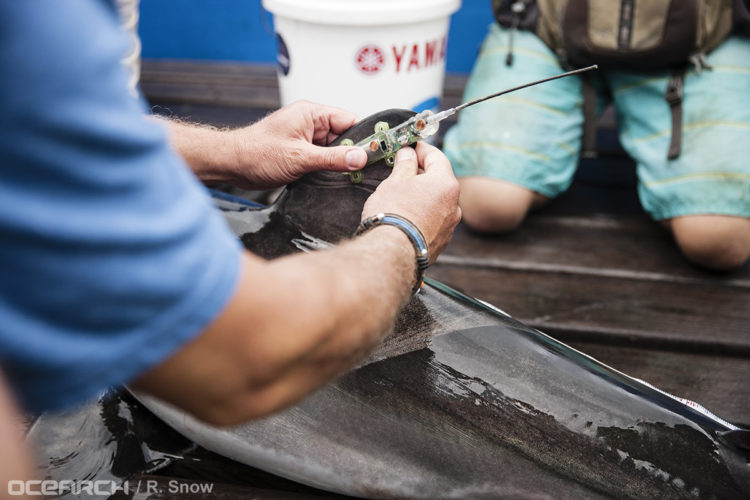
Now that the shark was clear of the water, the research team quickly boarded the lift and began working on the shark. To increase efficiency, each team member was assigned a specific task to complete (take measurements, note observations, draw blood, collect a fin clipping for DNA analysis, tagging, and affix the SPOT tag to the dorsal fin). In less than fifteen minutes, all tasks were completed and the shark was lowered back into the Atlantic Ocean where it swam off strongly making it the first YOY white shark to be SPOT tagged in the Atlantic Ocean.
The tagging of this 4.6-foot-long, fifty-pound female YOY white shark, which was appropriately named Montauk (@SharkMontauk), was only the beginning of this groundbreaking expedition. Over the next several days, the team continued to catch YOY white sharks. On August 23, the team had and tagged three YOY white sharks, one of which (Manhattan) was caught by Capt. Greg Metzger and the crew of the Long Island Shark Collaboration.
By the end of the expedition, the research team caught, tagged and released a total of nine YOY white sharks. Even more exciting was the fact that OCEARCH began to receive pings from each of the sharks tagged shortly after their release (the locations of the sharks can be tracked on the OCEARCH Shark Tracker app or on their website at www.ocearch.org).
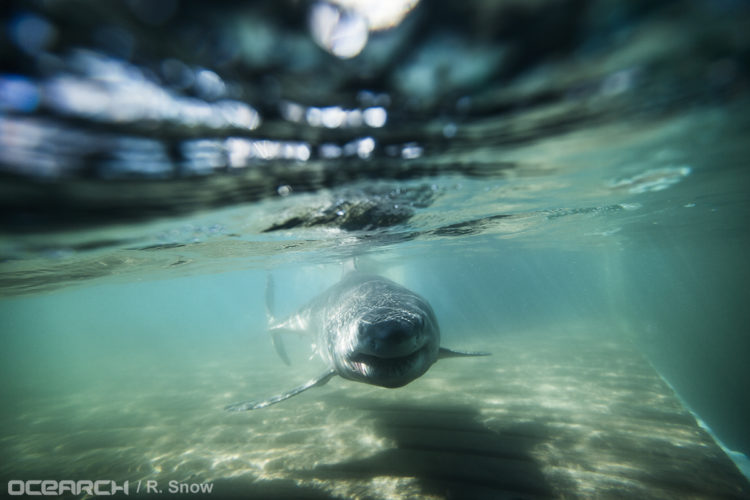
It was an honor to have been part of the research team on OCEARCH’s groundbreaking Expedition New York. Although the data does not answer the question whether or not this is the pupping site for white sharks, it does support the notion that the waters around New York are an important nursery area for YOY white sharks. The tags these little sharks now carry will help scientists understand where and when they use New York waters, what specific habitats they prefer, and where they go when they leave the area in the fall.
Really fantastic! Thanks so much.
Nice job thanks