
by Charles Witek III

Last August, I was bitten by a shark. It wasn’t a very big shark — it weighed about 50 pounds — and it wasn’t a very big bite, but it was embarrassing enough all the same. In more than 30 years of shark fishing, it was the first time that I ever late a shark get a tooth into me. The feisty little make was set loose, and I was content to see it swim out of my life forever. Except, in this case, “forever” didn’t last very long.
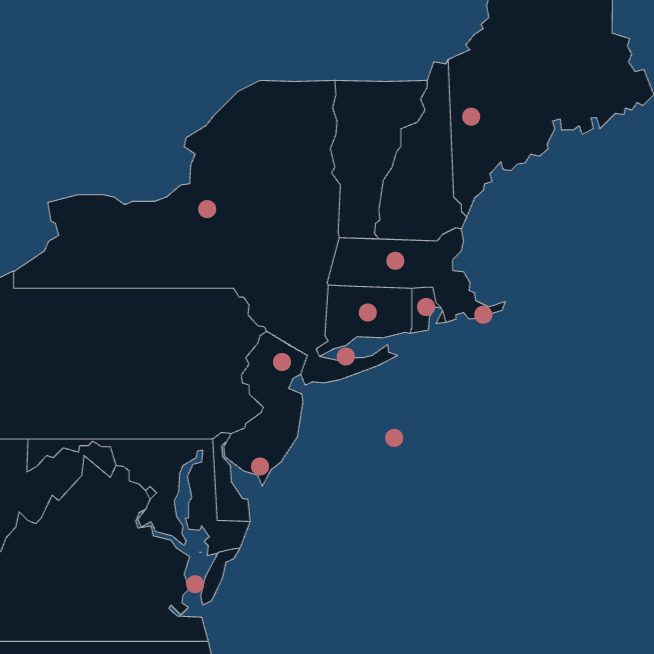
About three months after the shark was released, I heard from her again. Or, more precisely, I received a note from the National Marine Fisheries Service (NMFS), which let me know that she had been caught again. I had last seen the fish south of Shinnecock, New York.
Seventy-nine days later, after swimming 144 miles, she was recaptured off central New Jersey at the edge of the continental shelf. NMFS knew this because before the shark was set free, a tag from the NMFS Cooperative Shark Tagging Program had been affixed near her dorsal fin. When she was caught again, the Program was notified, and the information gleaned from her recapture was added to a growing database that provides scientists with insights into makos’ life histories and the health of the mako population. Similar information provided by tags placed on other species helps biologists understand and manage those species as well.
The Cooperative Shark Tagging Program is one of the oldest and arguably the most successful collaboration between anglers and fisheries scientists. It began half a century ago, when most anglers held sharks in contempt. Even after the angling press started to run stories regaling the late Capt. Frank Mundus and “monster fishing” aboard his Cricket II, sharks were disdained by traditional offshore anglers who would only hang marlin, tuna and swordfish from their yacht clubs’ scales. They grudgingly admitted that the leaping mako could be considered a legitimate “gamefish,” but all other sharks were dismissed as “cowardly,” “savage” and “brutes,” unworthy of a respectable angler’s attention.

Instead, anglers generally viewed sharks as enemies to be killed. In the Northeast, party and charter boat crewmen often shot or harpooned sharks that threatened hooked fish. Farther south, sharks frequently mutilated prized billfish and tuna. So, just before major events, tournament directors began holding shark contests in an effort to put a temporary dent in the local population and reduce the number of mutilated fish. Even the few pioneering shark fishermen showed little respect for their quarry. Most fish caught were killed, hung on the scales and then, except for the makos, dumped out at sea or trucked to a local landfill.
At the start of 1962, shark conservation was not on many anglers’ agendas. By the time the year ended, that had begun, ever so slightly, to change.
The reason? That same year a young biologist, Dr. Jack Casey, took charge of the U.S. Fish and Wildlife Service laboratory at Sandy Hook, New Jersey. The lab was involved in a number of projects, including the study of North Atlantic sharks. Like any federal fisheries laboratory, its resources were limited, and out of Casey’s efforts to get his work done despite such limitations, the Cooperative Shark Tagging Program was born.

Initial efforts were modest. In the first year, he signed up fewer than 100 recreational and commercial fishermen who would tag sharks with numbered plastic “roto” tags originally designed to identify cattle; instead of ranchers pinning them through the ears of calves, Casey asked fishermen to attach them to sharks’ dorsal fins. Affixing the roto tags to the dorsals of active and uncooperative sharks wasn’t an easy process, but enough fish were tagged to keep the program alive. In 1965, the roto tags were replaced with the “M tag” still used today; it consists of a metal dart implanted in the back of the fish near the dorsal fin. The dart is attached to a waterproof capsule containing a numbered plastic sheet bearing a unique identification number and explaining, in five languages (English, Norwegian, Spanish, French and Japanese), how to report a recaptured shark.
A postcard stamped with the same identifying number is provided with each tag; when a shark is released, the angler sends that card back to the program office (which was transferred to NMFS 30 years ago and is now located in Narragansett, Rhode Island) with basic information about the tagged shark, including species, size, sex, where and when it was caught, and its condition upon release.
Although the tagging program started off slowly, as more fishermen learned about it, participation steadily increased. Shark fishing was growing in popularity, particularly among anglers who were new to offshore fishing and did not share the prejudices held by earlier generations of bluewater fishermen. Casey and his staff seized this opportunity and tirelessly promoted tag and release; they worked with tournament directors, fishing clubs and charter boat captains, as well as with commercial fishermen throughout the Northeast. Their efforts were aided by the inherent attraction of the tagging process, in which a released fish no longer disappears into the abyss but rather swims away carrying a tag—like a message in a bottle, it is set loose back into the sea with the hope that it will be returned one day, along with a tale of its travels.
Tagging can be addictive. I made my first shark-fishing trip in the summer of ‘77 aboard Captain Charlie Donilon’s Snappa. The boat was docked in Galilee, Rhode Island — Casey’s backyard – so it was of little surprise that Captain Donilon was a tagger and knew Casey well. On that first trip, we caught five sharks, but the only one I remember was a 150-pounder that was tagged and eventually re-caught; when I received the report some months later, I was as “hooked” as the shark had been. Although sharks are tagged to provide data for researchers, it’s impossible to deny that it also serves to satisfy an angler’s curiosity about what happens to “his” fish after release: Does it survive? Where does it go? How long does it live? How fast does it grow?

Dr. Greg Skomal discusses the different types of shark tags while fishing for blue sharks with the OTW TV crew off Martha’s Vineyard.
A few of “my” sharks have been recaptured far from Long Island. One blue shark traveled to Venezuela’s La Guaira Banks, another was retaken off the Flemish Cap in the middle of the North Atlantic. However, some of my most interesting tag returns weren’t from the fish that traveled the farthest, but rather from fish recaptured close to home. A few of the blue sharks that I released south of Shinnecock were recaught one or two years later just a few miles from where they’d been tagged, suggesting that at least some individual sharks migrate in predictable patterns and pass through the same waters each year. If that is truly the case, it is hard to deny that releasing fish today helps to ensure good fishing in future seasons.
I’ve tagged quite a few sharks over the past 35 years, but they and the data they provided make up a very small share of the fish caught and recaptured over the 50-year life of the Program. The Cooperative Shark Tagging Program has attracted more than 6,500 individual participants in North America and Europe. Most are recreational anglers, but scientists, federal fisheries observers and members of the commercial fishing community are also well-represented. As of last December, 237,801 sharks, including individuals representing 52 separate species, have been tagged, with blue sharks, shortfin makos, sandbar sharks, tiger sharks and black-tips among the species tagged most often. In addition, 14,435 tagged sharks, representing 33 different species, have been recaptured. Once again, blue sharks, sandbars and shortfin makos top the list, and once again, many of those were caught by anglers, although commercial nets and longlines were also responsible for a substantial number of tag returns.
Some of the tagged sharks were re-caught within a very short time; others remained at liberty for years. One sandbar shark carried its tag for 27.8 years before it was caught again. Some species, such as nurse sharks, are not great travelers, and are usually recaptured very close to where they were released. Other sharks wander: a blue shark tagged off Shinnecock was recaptured 8.4 years later near Ascension Island in the south Atlantic, 3,997 nautical miles away. Another blue shark logged 3,740 miles between the point of release and the place of recapture. Such distances become all the more impressive when one realizes that sharks do not swim in straight lines.
Returned tags can provide other valuable information. For example, the proportion of tagged fish that are ultimately recaptured gives a good indication of the level of fishing pressure borne by each species. The 1% recapture rate for blacknose sharks does not suggest a problem, but the 13% recapture rate for shortfin makos might lead biologists to more closely monitor the health of that population.
Even with the information provided by the Program, there is a lot that biologists and fisheries managers don’t know about sharks; every new recapture helps to fill in the blanks. Given the pressure placed on shark populations in the North Atlantic and elsewhere, more information is badly needed if shark populations, and a viable recreational shark fishery, are to survive well into the future. That being the case, anglers who regularly participate in shark fishery should seriously consider participating in the tagging program as well. The investment is minimal, as NMFS provides the tags, a tagging needle, instructions and information on shark identification. All the angler has to provide is a tagging stick, which can be a simple 6-foot length of 1-inch dowel with a hole drilled in one end to hold the needle, or a more expensive anodized-aluminum factory model (which will also need its own threaded tagging needle).
To be sure that recaptures result in meaningful data, anglers should learn to accurately identify any sharks likely to show up in the chum slick. If the tagger and the fisherman who recaptures a shark disagree on identification, the shark will be classified “unknown” and the data rendered worthless (as my little mako was, until I provided NMFS with photos to clear up the confusion).
Once armed with the basic equipment and a rudimentary knowledge of shark ID’ing, an angler is ready to start tagging fish and make a contribution to science. When a tagged shark is caught and the tag returned to NMFS, both the tagger and the fisherman who returned the tag will receive a letter describing where and when the fish was tagged, where and when it was released, the distance that it traveled, and the time it was free. Along with the letter, they will also get a hat bearing the logo of the Cooperative Shark Tagging Program.
It’s a nice hat. But it’s even nicer to know that by tagging sharks and helping researchers learn more about them, you are doing your part to help ensure that shark populations can be managed sustainably so that anglers can enjoy shark fishing for many years to come.
I would love to participate in this tagging program
Would like to participate in a tagging program.
Would like to obtain a tagging kit if possible thanks. Dave
I would love to join this team. How can I tag sharks.
We are a group of guys that landbasedsharkfish out of Ocean City Md. We land Hammers, Tigers, Sandtigers, Sandbars, Duskys, Silky’s, We would love to start tagging these shark to help out in any way. How can we go about doing so with the right tags. Please get back to me. Thanks Nick.
Would love to participate in the tagging program.
how do I get tags? We average 5 to 10 sharks a day, June through August.
How can I start tagging and help out?
How do I get involved in the tagging program?
Thank you.
I would love the obtain a shark tag kit to help you guys out
Is this program still going on and how can I get setup?
Thanks
Shane