
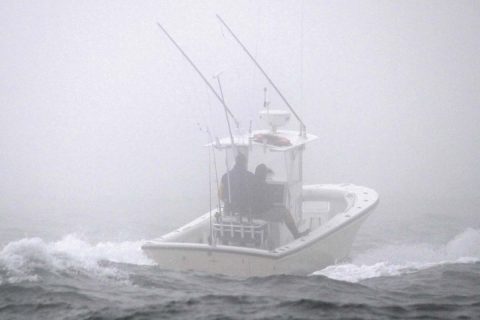
One of the great dangers of summer boating is navigating in poor visibility. When the heat of summer rolls in, sea waters remain cool. Hot, humid air and cold water create fog, which can blanket the coastline, rolling in and out with the wind.
A morning departure running at 30 knots in clear weather can turn into a white-knuckle 10-knot creep before noon. An evening run for dinner at a favorite harborside restaurant might turn into a hair-raising trip home when fog rolls in after sunset. With increased boat traffic in the summer months, it’s a dangerous combination.
Visibility in fog can range from a mile to a few dozen yards and change in an instant. A boat moving at 20 knots covers almost 100 yards every 10 seconds. That is a perfectly safe speed in some circumstances and an extremely dangerous one in others.
Know the Navigation Rules
No matter how skilled or experienced a boater you may be, limited visibility decreases your margin of error in approaching or crossing situations. The U.S. Coast Guard’s Navigation Rules states:
“83.19 (b) Every vessel shall proceed at a safe speed adapted to the prevailing circumstances and conditions of restricted visibility…”
There is no precise definition of what “safe speed” is, and “prevailing circumstances” is open to interpretation. Ultimately, the full responsibility of safe navigation is on the captain. There are no excuses or grey areas in the rule – if a collision or accident occurs and you are underway, you will likely be at least partially at fault.
It’s important as a boater to read and understand the USCG Navigation Rules. If you boat at night or in fog, you absolutely must fully understand the section of rules concerning lights and sounds.
If you do not have radar, slow to a speed where you can hear sounds forward and to the sides of the boat, and keep your speed slow enough that you can make an evasive move should a boat loom out of the fog. Using 100 yards of visibility, if you are moving at 10 knots, you will cover 50 yards in 10 seconds, which will give you barely enough time to evade another boat coming at you at the same speed. (Don’t forget that a boat approaching you in the fog is also going 10 knots, so your closing speed is 20 knots.) Also, in fog, an enclosed helm has a fraction of the visibility of an open boat because the driver may be blinded by glare and condensation.
Assuming you are a powered vessel, Rule 35 (a) – Sound Signals in Restricted Visibility, also applies. “A power-driven vessel making way through the water shall sound at intervals of not more than 2 minutes one prolonged blast. That rule, combined with Rule 19(e), “… every vessel which hears apparently forward of her beam the fog signal of another vessel…shall reduce her speed to a minimum for which she can be held on course,” gives both boats on an approaching or crossing course time to take avoiding action.
I keep a $10 West Marine air horn by my helm. In fog situations, I designate one of my crew to lean out the portside window and sound it every minute. It’s cheap, simple, and reliable. Sound signals and safe speed will keep you safe in restricted visibility. I cannot emphasize enough that running at speed in fog without radar is both dangerous and irresponsible. Slow down, take your time, and get your crew home safely.
Radar: Know it Before you Need it
When I first learned to use a marine radar, the small hooded green CRT displays were difficult to see and performed poorly in any sort of sea conditions. Today’s digital and HD radars combined with bright-colored 12” displays are amazing in comparison. You can pick out lobster pots a half-mile away some of the time. However, if you spend any time navigating by radar in restricted visibility, you learn that radar is not infallible, and it takes concentration and active operation of the radar controls to pick up and track potential targets. To be a good radar operator, you cannot take your focus off that display or you will potentially lose situational awareness and possibly miss something important.

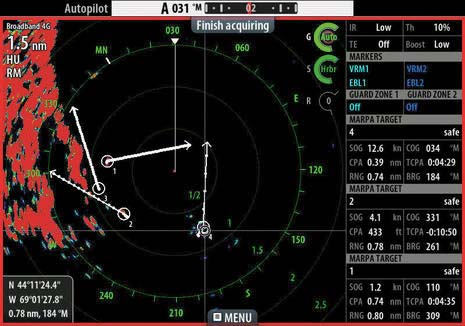
A marine radar with automatic radar plotting aid (ARPA) capability can create tracks using radar contacts.
ARPA and MARPA
Every radar manual starts with the same message – use your radar during the day, when you can correlate visual observation with the radar display to become familiar with both its operation and display. That way, when you need to use it in low visibility situations, it will be second nature to adjust gain, clutter, and range to best see what is out there.
Let’s talk about speed and radar operation in low visibility. I boat hundreds of hours a year and regularly make long-distance offshore runs in low visibility. Many of those miles are done at my 20-knot cruise speed under pure radar observation. How do I remain safe in those conditions?
First and foremost, if I have any doubts about what is in front of me or detect a potential threat, I slow to 6 knots or less and focus on evasive action. If I am running at speed in restricted visibility, nothing that is moving gets within 2 miles of me without being tracked using my radar’s MARPA (mini-automatic radar plotting aid). If the closest point of approach is going to be less than a half mile, I plan for and take early evasive action, if possible; if not, I slow down. No boat gets within a half mile without me slowing to a crawl. Better safe than sorry!
Second, I have an accurate autopilot that will keep me within 2 degrees of my course in all conditions. I establish a safe point-to-point course that keeps me well away from obstructions, and manually set the autopilot to that course. That diminishes my need to worry about staying on track. I still need to monitor my track and my time to destination, but it doesn’t take the full focus that would be needed for manual steering.
In areas of restricted navigation, like a narrow navigational channel, I slow to 6 knots. Again, better safe than sorry. It’s one thing to blast along at 20 knots in open offshore water, but safe speed with restricted visibility in a narrow channel is headway speed, no more. The most dangerous parts of a 50-mile voyage by radar are the first and last miles, when you exit or enter a harbor.
I have multiple screens at my helm, and at night or in fog, I dedicate my hard-top-mounted display to radar and put radar overlay on the GPS display in my dash. This allows me to focus on both navigation as well as any targets, and it gets a second pair of eyes focused on the radar display above us.
I constantly manipulate the range to both pick up anything a few miles out as well as make sure there is nothing in close. A typical radar display has four rings, each representing one-quarter of the total range. If your range is set at 2 miles, each ring is ½ mile. If the range is set at ½ mile, each ring is 1/8 mile or 600 feet. Most radar displays will lose targets in the inner ring or even inner two rings, depending on sea conditions. Remember, a radar beam sweeps in a 360-degree circle. If the boat is rolling on a wave as the beam passes by a target, it might miss that target for a sweep or two.
I cycle my radar in and out from a 4-mile range to a 2-mile range, then to ½-mile range. I know it will pick up larger vessels at 3 to 4 miles and smaller center consoles at 1 to 2 miles, but it will lose most targets in the inner ring. I want to find targets in one of the outer two rings and then switch range downward as I approach them to keep those targets in clear view. When I see an approaching blip that is not stationary, I put my radar’s cursor on it and make it a MARPA target. The radar will then compute its Course Over Ground (COG), Speed and Closest Point of Approach (CPA), and give me a vector line on the target to help visualize its direction. While MARPA is not 100% accurate, it helps me better understand how a target is moving. If the CPA is multiple miles away, I can continue at speed safely; however, if it’s less than a mile away, it’s time to plan an evasive course or reduction in speed.
As a target gets inside 2-mile range, I start an evasive 45-degree course change that aims behind the target. I also use my sound horn every minute as an additional alert. Inside of 1 mile, I want to make sure the approaching target’s course will safely pass outside of the inner ¼-mile ring and, if needed, I will either slow to a crawl or stop completely.
Don’t Rely on GPS
As someone who started boating with a compass and a watch, GPS has become an incredible tool for navigation and safe boating. When it first became available to the mass market in the early 90s, it had 100-yard accuracy and could not be trusted for precise navigation. Now, $500 units have 3-yard accuracy. Cartography on chartplotters is incredibly accurate within the limits of the original charts and the electronic updates (which you may or may not have applied to your unit).
GPS can and will kill you in restricted visibility if you put full faith in it without using either radar or your eyes as additional input.
I learned this lesson in the summer of 1992 with my first Raytheon GPS unit. I felt confident to fish an inlet late into a foggy evening because I “knew” that if I could creep out past the tip of the west jetty, I could point a path for my home harbor’s entrance, keep my 19-foot Mako straight for 2 miles, and arrive safely in the dark.
What I didn’t know was:
• Keeping a small boat straight in the dark and a 2-foot chop with no horizon and no visual marks is impossible.
• In the fog at night, both my glasses and the GPS screen fog up, leaving me blind.
A GPS point-to-point heading might get me where I want to go, but if there is anything between me and the destination, the direct course may take me into danger.
In this instance, items 1 and 2 knocked me off course. I found myself closer to shore than my original track, and I came within 5 yards of running up on a stone jetty. That experience and the lessons it taught me have stayed with me since. GPS still is a valuable visual tool that should be used to keep you on course, but it is not infallible. Do not trust GPS alone in limited visibility; set a safe point-to-point course with it and use the rhumb line from your location to the next point as a visual tool to stay on course if you don’t have an autopilot.

Keep your Eyes Moving
In restricted visibility, it’s important to keep your eyes moving from one piece of information to another. My eyes are constantly moving between 4 places: First is a 10-second scan of the water in front of me moving left to right from 10 o’clock to 2 o’clock. That is followed by about a 10-second glance at the radar, again with emphasis on that same sector in front of the boat. Next is a brief 3- to 5-second glance at my GPS to verify we are on course, followed with a quick 3- to 5-second glance at my engine gauges to ensure everything is fine there.
Put it all Together
At some point this summer, you will likely find yourself boating in fog. While it can be intimidating and confusing, a few simple steps will help you navigate safely to your destination. Familiarize yourself with the U.S. Coast Guard Navigation Rules and Regulations available online at navcen.uscg.gov.

Use common sense, slow down to a speed that feels safe, and have others on the boat looking and listening for other boats. Put your lights on and remember to sound your horn every minute. If you have radar on your boat, learn how to use it and read it in clear conditions so you are comfortable with its operation. Most important, drive defensively and be ready to take evasive action as early as possible to avoid close approaches.
This article was originally published online in July 2018.
VERY VERY GOOD INFO GUYS !!! BUT LET ME TELL YOUR READERS SOMETHING, TO BE GOOD AT THIS NAVIGATION GO OUT WITH SOMEONE THAT KNOWS WHAT THE HELL THERE DOING AT NITE AND PRACTICE . THERE WERE TIMES WHERE I JUST THREW OUT THE ANCHOR AND SAT THERE UNTIL I COULD SEE WHERE I WAS GOING. ONE TIME I WAS ONLY 10 FEET FROM SHORE WHEN I WAS ABLE TO SEE WHEN IT ALL CLEARED UP. COULD YOU IMAGINE IF I WAS BALLS OUT ID BE DEAD. WHEN IN DOUBT THROW THE ANCHOR OUT.
Yeah ok Lou. Did your girl scout leader tell you that?
I am impressed with the technological progress of current radar and its reasonable price for more users. Your article is so informative and radar users should pay attention to your recommendations. Using radar in clear visibility makes the operator more aware of how the physical objects appear on radar before the need arises.
Chief Radarman in Charge, USCG Radarman School 1968-1970
WORKED FOR ME IN OKINAWA
Excellent article. Hopefully everyone who sees this will read it to the end.
Excellent article, thank you. Hope some of the charter guys read this, guess they think the rules need not apply to them?
Great article. I will add my two cents. With my single screed GPS & Radar I always find a BTW and then use my compass to insure I am on a steady track. Using the GPS for COG has delays and I find it’s critical to maintain a stable track for the GPS / Radar overlay to be accurate. Lots of practice on sunny days help.
a $10 dollar air horn from west marine being blasted every minute will last you about 5-10 minutes! Best of luck with that!
West Marine sells a horn that you can pump up so you never run out of air. Even better it’s plastic, so no more rust stains. Best thing is to get a VHF radio with fog signaling and a loud hailer. One less distraction when you’re already overloaded. New radios also can provide MRASS to activate ATON’s. Very handy if you have these where you boat.
Great article. Worth bring to the forefront again! Maybe a re- publish 🙂
Situational awareness is critical. As they taught my daughter at SeaEd in Woods Hole, you’re on one electrical fuse away from being Christopher Columbus