

Bundle up to beat the crowds in Pulaski
In the fall, the Salmon River in Pulaski, New York is not a place for quiet streamside reflection. It is not a place to seek solitude or refuge from the hustle and bustle of everyday life. Thousands of big, migratory fish flood the river after several years abroad in Lake Ontario, and in turn, thousands of anglers line the banks for a chance to catch them. In September and October, when mild weather rules and big king and coho salmon run the river, shoulder-to-shoulder crowds are the rule, not the exception. Even in November as the salmon numbers dwindle and the steelhead numbers bloom, you can still expect to share the banks with an army of anglers.
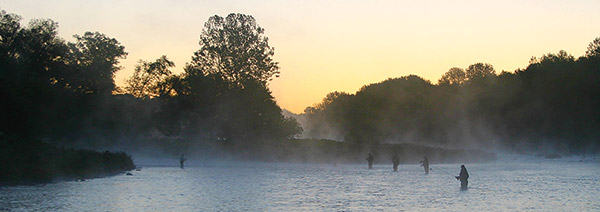
Fortunately, even tightly packed, the crowds of the Salmon River are amiable. Most fishermen have travelled a good distance to get there and have high spirits—as most fishermen should—while on their fishing vacation. The crowds add a certain charm to the fishing in Pulaski. A chorus of hoots and hollers when a big hooked steelhead cartwheels downstream is often followed by a string of attaboys as the lucky angler reclaims his spot upstream.

Friendly atmosphere or not, a crowded river has its challenges—such as pressured fish, limited casting room, and crossed lines. But, there are several ways to separate from the pack and still catch fish on the Salmon River. Fishing weekdays is one. Going later in the season is another. The crowds thin out as the temperatures drop. The number of anglers fishing in December and January is a fraction of that in October and November—and the fishing for steelhead is as good, if not better. If you fish with a guide, whether he works the river in a driftboat or on foot, he’ll know some out-of-the-way spots that the masses overlook. Lastly, you can spend a little extra and fish the Douglaston Salmon Run (DSR), a privately owned stretch of river where a daily pass must be purchased and the number of anglers is limited. When I visited Pulaski last year with my friends Joe Cermele and John Frazier, we did all of the above.

Our plan for a winter steelhead session was hatched on a balmy July night during a sportfishing trade show in Florida. Frazier, the senior editor of Saltwater Sportsman Waters and Cermele, fishing editor of Field and Stream, and I hit an oyster bar on the outskirts of Orlando on the last night of the convention, where, after just enough oysters and too many beers, the topic of steelhead came up. Frazier, a Florida native, had never caught one, which prompted Cermele and I to tell him that his life wouldn’t be complete until he felt a steelhead on the end of the line.
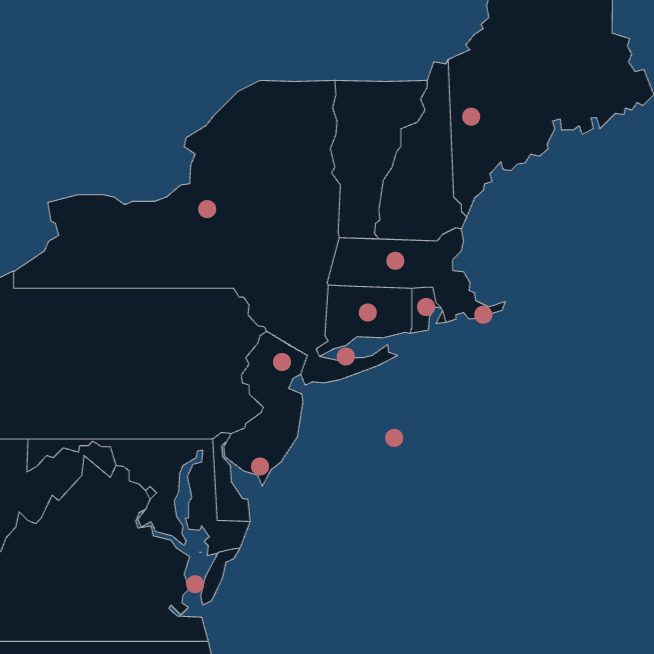
Plans to fish made in bars over beers rarely come to fruition, so I was a little surprised when five months later, a long way from Orlando, Cermele, Frazier and I were casting to steelhead from the banks of the Douglaston Salmon Run in Pulaski, New York.
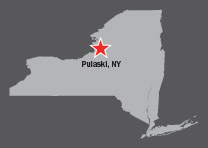
The land now known as the Douglaston Salmon Run (315-298-6672; douglastonsalmonrun.com) was settled in 1807 by Colonel Rufus Price, aide-de-camp to General George Washington. Current owner, and longtime New York State Senator Doug Barclay, is a seventh-generation descendant of Colonel Price.The DSR occupies the last 2.5 miles of the Salmon River before it enters the estuary of Lake Ontario. It is the first stop for migrating steelhead, salmon and brown trout, bound for their spawning grounds upriver. The Douglaston Salmon Run allows only 350 fishermen on the river each day. A daily pass costs $50, while a Limited Season Steelhead Pass, good from November 15 to April 30, costs $300.
The Douglaston Salmon Run sits on the lowest 2.5 miles of the Salmon River. Steelhead moving through the run are fresh from Lake Ontario, meaning they have not yet run the gauntlet of flies, lures and baits waiting in the public sections of the river. This makes them a bit more receptive to anglers’ presentations. Fish in the DSR are on the move, rarely holding for very long, as they do in some of the deeper holes upriver. Nevertheless, when the run is on, anglers will have frequent shots as schools of fish enter the river.
On the first morning of our trip, the three of us spread out in a long pool in the DSR and casted egg flies.
From the time the steelhead first enter the river in October, to the time they leave in May, eggs are tops on their list of preferred foods. It’s the eggs of the salmon that draw the steelhead in, and the eggs of the brown trout that sustain them through the late fall and early winter. Come spring, the steelhead will even eat the eggs of their own kind. While aquatic insects like stonefly larvae inevitably end up on the steelhead menu as well, for the lower portions of the river, guide Gary Edwards suggested we stick to eggs.
John hooked up first. I heard shouting and turned to see his rod tip bouncing and the fly line shooting through the guides. Once the loose line was cleared, the reel whined as the fish shot across the river, attempting to make its escape under a fallen tree.

The odds are definitely not in the angler’s favor when it comes to landing steelhead. These souped-up rainbow trout fight like the devil, leaping, spinning and doing everything possible to free themselves of the hook. Failing that, a hooked steelhead will simply turn and run, putting the current to its back and firing up the afterburners for a big run downstream, forcing the fisherman to follow. Further complicating things are the light leaders needed to get the steelhead to bite in the first place. Steelhead have sharp eyesight, and in most cases will easily pick out and avoid a fly tied to a 10- to 12-pound-test leader. As a result, 6- and 8-pound-test are usually employed, with some fishermen scaling down to 4-pound-test when the fish get especially picky. Since the average Salmon River steelhead weighs 5 pounds and fights like he’s 10 pounds, broken leaders are a common cause of the “fish off” call.
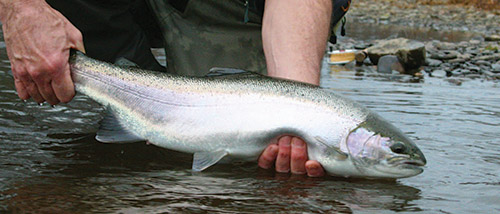
John’s fish hunkered down and refused to budge. As he put on more pressure, the fish began to move, but made a last surge that popped the leader.
Often, steelhead bites come in twos or threes, as if some silent signal passes between the fish that it’s time to chew. I’ve seen it plenty of times when a pool, lined by anglers having no luck, suddenly comes alive with bent rods and thrashing steel. So, after John hooked up, I wasn’t too surprised that only a few minutes later, when I lifted the rod after a slight tap, a steelhead starting thumping at the other end of the line.
If you want to catch steelhead, you need to keep your offering on the bottom. These fish move upstream with their bellies on the rocks, and as water temperatures drop in winter, the distance a steelhead is willing to move for a meal shrinks.
Use enough splitshot so that you periodically feel the weight ticking the bottom. Too much splitshot, however, and you’ll frequently snag up. Play with the weight until you find the right number and size of splitshot to give you the perfect drift.
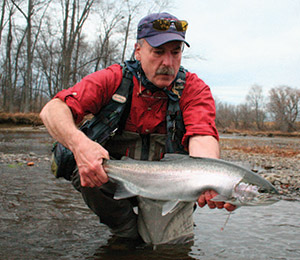
Once you dial in the drift, you can consider fly selection. Guide Gary Edwards told us at the beginning of the trip to change flies often, every 15 minutes, to show the steelhead something new. Sometimes a drastic change in color will get an immediate response. I was partway through my second drift after switching from an orange Esatz fly to a pale pink Glo Bug Egg when I felt the grab. That was the first of several times during our December trip that a fly change resulted in an immediate bite.
That fish threw the hook before Gary could get the net under it, but my shot at redemption came minutes later when a colored-up male steelhead ate the same fly and dragged me downstream a bit before I slowed him down long enough for Gary to get him in the net.
After that, Cermele had the magic touch for the rest of the first day, hooking several fish on a pink-and-yellow Esatz. I cycled through my fly selection several times but never found something the steelhead wanted, driving home another important steelhead lesson—they can key in on one color and size, and hit that all day while ignoring everything else.
Joe had a couple “on and gone” fish, and when he finally got one buttoned up, it launched downriver, taking Joe with it, before he was able to pull it into some slower water and get it to the net.
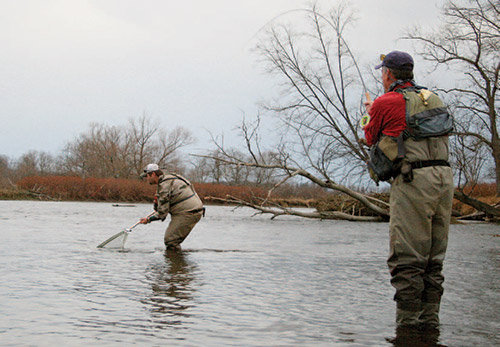
Landing a steelhead is all about angles. You have to be ready to move once you hook the fish, explained Gary Edwards. He stressed keeping parallel to the fish and not letting it move too far from your position. The more line out, the greater the likelihood of a pulled hook or broken leader. It’s also important to use low rod angles to steer the steelhead away from cover. Changing the rod angle can also help pull the fish out of the fast water, where it will be easier to control. Once the fish is under control, the net man can move downstream of the angler and seal the deal.
Fifty yards from where Joe hooked his fish, I stood ready with the net as he pulled the tired fish into range. Once Joe’s fish was tuckered out and splashing on its side, I slid the net under it in one smooth, fast stroke.
The next two days followed a similar pattern, with Cermele and Edwards putting on a steelhead clinic for Frazier and me. Frazier never did get his first steelhead to the net, though he fought a few. As he prepared to head back to Florida, he didn’t seem discouraged. Instead, he was already making plans for another shot at cold steel.
Great article. Nothing better than a big steelhead on light tackle. Landing them with consistency is like being a 300 hitter in baseball!
Well written and extremely informative article. I would say that December, although very good for chromers isn’t as good as November. There is a certain zest that the fish have when the temp starts to drop near freezing at night. Once December settles in the fish hunker down quite a bit and you most definitely need to work a little more for the bite. There are exceptions to every rule so this shouldn’t be taken as gospel, just from previous experience.