
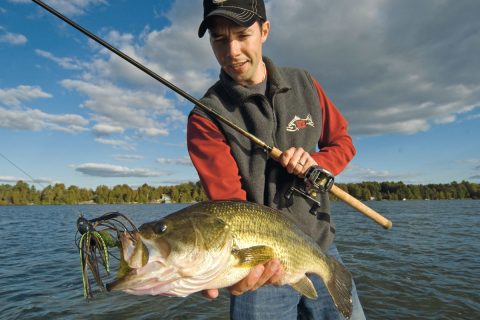
In the Northeast, we have the luxury of experiencing all four seasons while bass fishing. It’s a challenge because we must find ways to convince finicky fish to bite in a wide range of water temperatures and weather conditions. However, the benefit of this challenge is that it forces us to become some of the most versatile bass anglers in the country.
I have seen my fair share of what works and what doesn’t when it comes to bass fishing. Fishing for the University of Maine Orono and as a member of the Androscoggin Bassmasters has given me opportunities to fish around the state of Maine, across the Northeast, and beyond.
Along with fishing the small ponds abundant in Maine, I’ve fished major rivers like the Arkansas for the B.A.S.S. Junior World Championship, and the tidal waters of the Potomac River for the FLW College Series qualifying event. There are a few techniques that brought me success no matter where I have gone, and these techniques are particularly effective in the wide-ranging conditions we encounter in the Northeast.
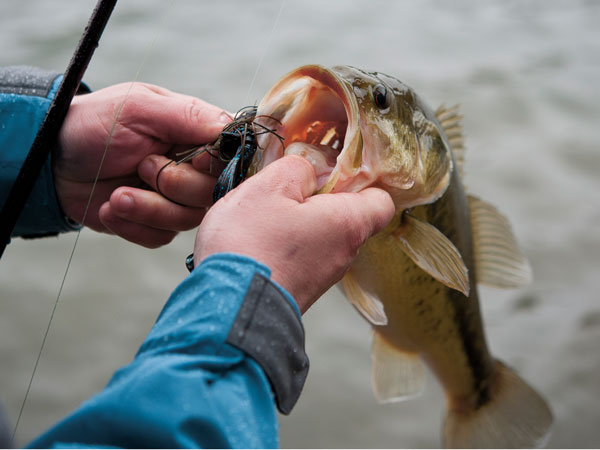
Having three different techniques ready to go at any time can be the key to catching fish that won’t commit to what you’re throwing. When fish are being difficult, they may only be feeding for a short window of time, so it is important to have other options on deck, ready to entice them to bite.
Rig #1 – Topwater
While I don’t recommend throwing a topwater in the early spring when water temperatures are still cool and the fish are sluggish, as soon as the water warms up to about 63˚F, you can get away with throwing a topwater pretty much all day. By midsummer, I focus on throwing topwater baits over flats and drop-offs during the morning hours.

Make sure to have a topwater rod rigged and ready because, at any moment, fish could begin busting on a school of bait on the surface. I recommend that you get a topwater bait as close to the activity as possible to ensure a strike. In such a case, I usually have a Heddon Zara Spook or a Bill Lewis Stutter Step tied on a 7-foot medium-heavy casting rod with a moderate-fast-action blank. I throw my topwater baits on 15-pound-test monofilament line because it floats on the surface of the water and gives a good action to the bait. Monofilament also has more stretch than braid, so you are less likely to rip the bait out of the fish’s mouth.

I use a longer rod to give myself greater casting distance, which is especially crucial when fishing clear water where the fish can see the boat at a distance. A medium-heavy blank gives me the backbone I need to control the fish while the moderate-fast-action tip gives me some cushion when setting the hook.

The Topwater Setup
- 7-foot, medium-heavy conventional rod
- 15-pound-test monofilament line
When I am fishing lily pads, I switch my topwater rig for a Kistler 7-foot, 3-inch heavy KLX casting rod paired with 65-pound PowerPro braided line and throw a Spro Bronzeye Frog. With all my setups, I use a 7:1:1 Johnny Morris Signature Series bait-casting reel. I use the same reel for all my setups so I am always comfortable with the feel of it in my hand. If you’re always switching reels, it can be hard to adapt and may lead to lost fish. Having the right setup for each type of topwater fishing is key to landing a high percentage of the fish that blow up.
Rig #2 – Weightless Soft Plastic
One of the first lessons I was taught at a young age was to always have a Senko or some type of unweighted soft-plastic lure ready to chuck when throwing a topwater. If a bass strikes a topwater but misses the hooks, it may not come back and strike again. In this case, reel that bait in as quickly as you can and follow it up with the weightless worm in the same area. Nine times out of ten, that bass will take the worm within a few seconds.

A Senko is a very versatile bait throughout the year because it can be used for fishing under docks and around rocks, weeds, and trees. I tend to use a 6-foot, 9-inch medium-light Kistler KLX rod and a spinning reel spooled with 12-pound fluorocarbon line for fishing Senkos around docks and rocks. I want my rod to be on the shorter side to give myself more casting accuracy and a lighter rod to accommodate the lighter lure weight. However, in the weeds, I go with at least 15-pound fluorocarbon line. It has less stretch, which gives me a stronger hookset to make sure the hook punctures the fish’s mouth. What makes this bait so versatile is that it falls slowly with the lifelike action of a worm. There is something unexplainable about this bait that makes it great around structure while it is falling and also when it is just sitting on the bottom.
The Topwater Setup
- 6-foot, medium-light spinning rod
- 12-pound-test fluorocarbon line
Rig #3 – Jig and Trailer
Another rig I always have set up is a jig that mimics a crawfish. This is my confidence bait that I’ll throw whenever the fishing gets tough. I always pair my jig with a 7-foot, 3-inch medium-heavy, fast-action Kistler KLX rod with a Johnny Morris Signature Series 7:1:1 baitcaster reel spooled with 15-pound fluorocarbon line. With my jigs, I prefer a heavier rod because it allows me to pull fish out of grass and away from any structure that might cause the line to break. I also like to have a fast reel that can keep up with the fish if it is coming toward the boat. Even more than the Senko, this versatile bait can work in almost any scenario you can think of, from 1 foot of water to depths greater than 20 feet.

There are plenty of jig weights and colors that work year-round in multiple situations. In the spring, jigs work best when fished slowly since the fish are sluggish. During the summer months, I use a 3/8-ounce black and blue Grizz Baits jig with a Big Bite Baits swimming craw in 1099 color. The reason I use a swimming craw is to give the bait a little more action compared to a chunk-type trailer. This bait can be used for fishing anything from docks and weeds to drop-offs and flats. For me, the best area for catching fish with crawfish-imitating jigs is around any type of structure; however, when on an open flat, a swimming jig that mimics a baitfish will work better because bass are on the move, actively feeding. I’ve had days on the water where I wasn’t catching any fish using tactics that I thought should produce, then after switching to my jig setup, started catching fish in the same areas. It’s a great example of the importance of fishing a go-to bait that you have complete confidence in.

The Topwater Setup
- 7-foot, 3-inch medium-heavy conventional rod
- 15-pound-test fluorocarbon line
Very good presentation
Great fishing site ———— all about fun ———– lures look great !!!!!!!!!!!!!!!!!!!!!!!!!!!!!!!!!!!!!!!!!!!!!!!!!!!!!!!!!!!!!!!!!!!!!!!!!!!!!!!!!!!!!!!!!!!!!!!!!!!!!!!!!!!!!!!!!!!!!
Great reading. I’m looking forward to more info. Growing up in the Midwest (MN WI), and now living in the NW (OR), Fishing is a great hobby of mine.
I’m in northest Florida and am having trouble catching bass. I usually fish near Lake Santa Fe and had a bite or two but nothing I could reel in. I’ve tried worm, top water and trolling with a minnow. Nothing has worked. Maybe it’s the high heat?
Spend the money and get a dozen shiners, wild not domestic. Go back to being a kid and get some Eagle Claw shiner hooks. 25lb fluoro leader tied to your braid with a double uni knot. Get a float with the slit so you can adjust the depth of your bait easily. Get next to the reeds or grass and set depth at 2 ft. Toss it in and set back for the fun and aggravation of shiner fishing!
I live just north of Tallahassee and 98% of the time I use a six inch heavy worm in June Bug. I don’t twitch it, I drag it along the bottom with about a 6 inch sweep. The 10 – 12 pounders I catch generally hit very light (learning experience to distinguish between a grass snag and the big boy. They will sit an barely nibble on it. I get them to take it by simulating a worm trying to wiggle free…..i.e. very light twitches. It may take 2 or 3 minutes before he decides to gulp it..With very slight tension on the line you can feel them nibbling. Also like the Googan scented baits.
I noticed that in the set-ups everything you are using is top water and it’s three different set-ups and you are using fluorocarbon line . Before you send these posts out check your posts before you send!!!
The three setups I use is:
1. 7ft medium 3000 spinning reel 10lb braid 8-12lb leader(poppers, small 3″ style senkos, small 1/8 spinnerbaits and buzzbaits)
2. 6’6″ medium baitcaster, 7.1-1 torrent baitcaster with 12-15lb line for 5in senks, 1/4-3/8 spinnerbaits, small crankbaits, lipless, 1/4 buzzbaits, spinnerbaits, 1/4 or so poppers, 1/4 oz football jigs.
3. 7ft medium heavy vengence rod with a lews 7.5.1 baitcasting reel with 30lb braid for frogging, spooks, jigs, really everything else and when needed will use a 15-25lb leader depending on if I’m doing heavy cover. Always used 30lb braid and never snapped off. Where I usually fish we don’t have the heavy vegetation like lake fork, Guntersville, Okeechobee, so using lighter line and on medium heavy setups plus I’m 5’3″ and always fished the one size down than many others and have always had amazing success. These are the only three rods and reels I use no matter what and all you can do or fish can be done on these setups. Whether close combat and accurate casts or fishing distant targets on weed lines and edges, I promise these setups will work and make you a better fisher person. Give one of the setups a try and see how they may work for you.