


Pictured above: This big bluefin fell to a Sebile Stick Shadd worked across the surface with an erratic retrieve meant to mimic sea herring.
Fine tune your presentation when jigging and popping for tuna.
You’d think a fish that eats while swimming as fast as 60 miles per hour wouldn’t have the chance to inspect its food too closely. But with an eye the bigger than a golfball, bluefin tuna get a pretty good look at what they’re about to mow down.
There’s no question that trolling and live-baiting are effective bluefin tuna tactics. Trolling allows you to cover water in your search and a frantically kicking live bait calls in the tuna from a distance, but when you know where the tuna are feeding, there are other techniques that are often more effective.

Jigging and popping have become some of the most popular techniques for targeting pelagic species, and for good reason. For one, the equipment is much lighter than the traditional trolling or live bait set up. The fishing is also far more interactive and, in the case of the popping, much more visual. But the caveat for this type of fishing is being certain you are presenting your jig or plug to feeding tuna. Unlike trolling and live-baiting, which can successfully be done “blind,” when jigging or popping, you must be seeing or marking tuna in order for these techniques to be effective.
Getting in range of feeding bluefin tuna is difficult. These fish are fast, and don’t stay in one spot for long, so when you get your shot, you need to make the most of it. If the fish are on top, one cast may be all you’ll get. Even jigging, when those big red boomerangs show up on the finder, you better be ready when dropping down, because that tuna isn’t going to stay under the boat for long.

Knowing how important it is to capitalize on each opportunity, three of the Northeast’s top tuna captains have dialed in what they want crimped to the end of their leader and how they want to present it to the Northeast’s most exciting gamefish.
Popping
Seeing bluefin blasting out of the water through balled-up baitfish schools is what tuna anglers dream of. If you can get the right lure in front of these fish, you’ll have the pleasure of watching a bluefin emerge from the depths to inhale it before going on a drag-sizzling run.
But bluefin aren’t bluefish, and they’ll be downright picky as to what the will and will not hit while feeding on the surface. You need to read the fish’s behavior, the predominant baitfish and the conditions in order to successfully catch a bluefin on top. Once you do, however, popping for bluefin can be more effective than trolling as you are constantly putting your lure in front of feeding fish, eliminating the time spent fishing potentially fishless water.

For Captain Terry Nugent of Riptide Charters, running and gunning is the name of the game. Nugent uses his Raymarine Super HD radar to find flocks of birds, and his twin Mercury Verado 300’s to get in range so his clients can cast lures into the feeding tuna before they go down.
Nugent fishes a wide range of waters from the tuna grounds south of Martha’s Vineyard around Chatham, out to Stellwagen Bank and into Cape Cod Bay. Fishing these areas, he encounters a wide range of baitfish. Halfbeaks (Atlantic sauries), mackerel, sand eels, squid and juvenile herring are all among the baitfish that Nugent has to imitate throughout the season.
“Sometimes you go out there and you know from the day before or from a buddy what baitfish the tuna are on,” Nugent says, “but other days you might not have that information.” On those days, Nugent goes with an all-around bait like a white weightless-rigged Hogy. The lure is a good representation of squid, sand eels and herring, and it works well when the tuna are in casting range.
On days when he knows what baitfish are out there, Nugent has found that using a lure a bit larger than the prevailing baitfish does not decrease the amount of strikes. He’s not too concerned with color. With blue, green, silver and white, Nugent has most of the bases covered. “I have mackerel patterns on hand for when the fish are feeding on mackerel, and when they’re on halfbeaks, I like lures with a little bit of purple, since halfbeaks have some purple in them. When the fish are feeding heavily on peanut bunker, lures with some pink seem to do pretty well because the undersides of the peanuts have a pink hue to them.”
One of Nugent’s favorite lures for throwing into tuna feeding frenzies is the Ocean Lures Riptide Tuna Series, which he helped design. The lures imitate herring and halfbeaks and other medium to large baits. These lures are built with a little extra lead to help add yards to the cast, which can important when trying to get your lure in front of a feeding bluefin.
While it’s not difficult to tell what the tuna are feeding on when the baitfish are jumping out of the water in plain sight, sometimes, Nugent explained, you can identify the baitfish from a distance by observing how the tuna are feeding.

“When the fish are packed really tight and the water looks like a Jacuzzi, usually that means they’re feeding on a big mass of small baitfish.” Yet when the tuna are launching themselves clear of the water, that often means that they’re on a bigger, faster-moving bait. Often, bluefin feeding on halfbeaks will appear on the surface in scattered, isolated explosions. This can make for difficult fishing, as the tuna are spread out over a wide area chasing individual baitfish, making it difficult to find a target to cast to.
More important than matching the bait size or color, says Nugent, is matching their movements with the presentation.
The notion that you need to be moving your lure as fast as possible to get a tuna to strike is not the case, explains Nugent. “I tell my clients that the bluefin swim sixty-miles-per-hour – the baitfish they’re eating don’t. You have to match the retrieve to the bait.”
For most baitfish – sand eels, juvenile herring, bunker and so on – this means a moderate to moderately fast retrieve, or “bluefish speed” as Nugent calls it, meaning how fast you would retrieve if you were targeting blues. The exception is when the tuna are eating large mackerel or halfbeaks. These baitfish are fast, and the retrieve should be similarly fast.
Rod tip action is important, Nugent says. Keeping the rod tip moving and getting the bait to dart and dance and splash on the surface draws more hits than simply reeling in straight.
Jigging

-photo by Gene Quigley
When big concentrations of big sand eels set up over structure, bluefin tuna arrive in numbers to feed on these slender baits. When this happens, dropping a jig through the bait balls to the depths you are marking tuna will put your offering right where the tuna are feeding, which may be the very bottom.
Few captains are as dialed into the Northeast bluefin jig bite as Captain Gene Quigley of Shore Catch Guide Service. Once he’s found the tuna, he lets the current dictate the jig size. The jigs need to be heavy enough to get down and minimize line scope, but light enough that they still flutter on the retrieve. On calm, dead-drift days, 80-gram (roughly 3-ounce) jigs are the ticket, while on days with a faster drift, jigs heavier than 300 grams (roughly 10 ounces) might be needed.
Quigley relies primarily on four colors – silver, gold, pink/silver and blue/silver jigs. “Lots of people like hot pink,” Quigley explained, “and it works, but ninety-nine percent of the time, I’m using a silver jig.”
With sand eels the primary forage item of the bluefin off New Jersey, slender jigs are key. Two of Quigley’s favorite tuna jigs are the Shimano Butterfly Jig and the Jersey Jay Tonno, but his go-to is the silver 150-gram Sting-O PBJ. This jig is effective when Japanese-style speed-jigging and yo-yo jigging, making it quite versatile on the tuna grounds.

Where the tuna are holding in the water column dictates what retrieve Quigley has his clients employ. Early morning, when the fish are feeding high in the water column, a speed-jigging approach is best, where the jig is worked erratically toward the surface.
Later in the day, when the bluefin feed on or near the bottom, Quigley has his clients keep the jigs deep. “Sometimes I have them leave the jig on the bottom and then pop it up, just like a sand eel. Other times, I’ll even drag the jig through the sand in order to get bites.”
The bluefin, Quigley says, will root along the bottom for the sand eels, just like stripers do in the surf, so by keeping the jigs deep, he gets more hook-ups.
The waters off the tip of Cape Cod, where Captain Bobby Rice of Reel Deal Sportfishing targets tuna are also home to big schools of big sand eels that the tuna, chow on all summer and into the fall. With fish keyed in on these long, slender baits, Bobby turns to similar-sized soft plastics to get bit.
His preferred lures are the RonZ baits. These lures have a unique head shape that gets down in a hurry. While no soft-plastic bait is going to descend as quickly as a metal lure, the RonZ gets down pretty quick. The tapered tail undulates on the way down, attracting strikes on the fall.
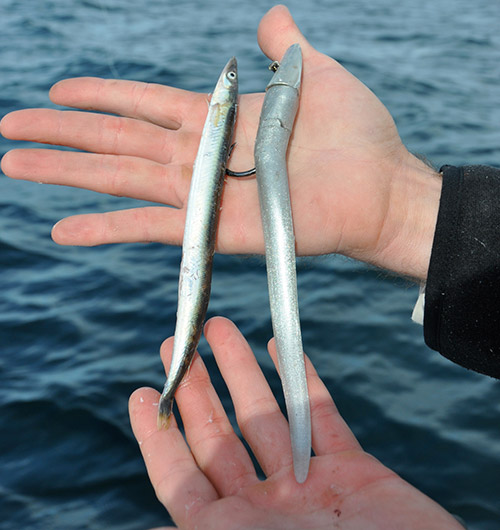
Instead of the frantic speed-jigging motion that tuna fishermen use when fishing Japanese-style tuna jigs, Rice works his jigs by dropping them to the bottom and lifting the rod tip and dropping it while reeling in the slack, almost as if the bait is working up a set of stairs as the boat drifts. Varying the retrieve is important, and sometimes a more frantic retrieve is needed. Reeling in while feverishly working the rod tip is another good way to attract strikes.
Don’t forget to deadstick as well. Deadsticking has been popular among captains overnighting in the canyons, where a jig is suspended off one of the outriggers allowing the boat’s rocking to give it action. While Rice doesn’t deadstick off outriggers, he does occasionally leave a RonZ drifting behind the boat. The drifting boat alone is enough to make the supple soft-plastic baits dance, and this is enough to tease a bluefin into biting.
Whether the tuna are feeding on top or down deep, one thing remains true — proper presentation is critical. Whether you’re erratically ripping a stickbait across the surface to mimic a halfbeak or popping a jig off the bottom to imitate a sand eel, making sure your lure is acting like the bait is at least as important than having a lure that looks like the bait. While minor tweaks in colors and lure size can help with finicky fish, get the retrieve right and you’ll get the tuna.
Thank you for the wonderful article. I was wondering about who was out at Stellwagon last weekend as we gazed out from the NPS visitors Center near Race Point. The whales were everywhere spouting water. Thanks again and hope to get out soon.
great article. i can’t believe how much i miss it! a severe auto wreck
that occured last year and 9 months in the hospital and becoming paralyzed from the waist down forced the sale of my boat. i am wondering if there are charter boat captains out there that could accomadate a single angler in a wheelchair? I live in Boston but would travel north to Maine and south as far as New Jersey. I was wondering if this could be posted so captains and anglers could read it and perhqps provide some suggestions?
Matt, did you ever get a response to your question about charter boat captains who could accommodate a single angler in a wheelchair?