
Cotton Cordell Red Fin
PRADCO-Fishing
3601 Jenny Lind Rd
Fort Smith, AR 72901
www.cottoncordelllures.com
www.lurenet.com
By Captain Bryan A. Oakley
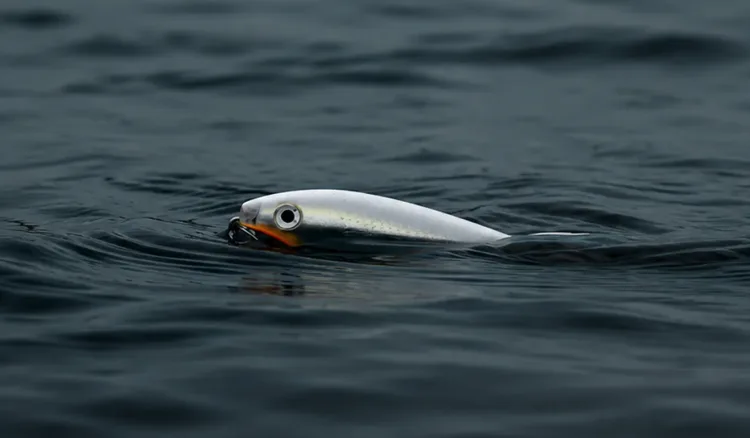
It’s late October, and I’m waiting in the parking lot near a shallow boulder field on the south shore of Rhode Island. The night is cool with clearing conditions; the wind has shifted to the northwest and the swells are dying 2- to 3-footers from a small fall nor’easter. As it transitions into full darkness, the dusk crowd fades away, disappointed about scratching out only a few small bluefish and school bass. I know large bass are around, so I quietly listen to the woes of the departing surfcasters and take the last swig of lukewarm coffee from my mug. I note the poppers and tins on their rods and silently clip a well-worn 7-inch Red Fin on my line. The chrome has chipped and faded into a patchwork of tarnished silver and bone white. This old warrior has seen many battles, and with a fresh set of hooks, it is ready for more. After wading out and climbing on a rock, I fire a cast, landing the plug in a pocket of clean water next to a car-sized boulder. I let the plug rest for 10 seconds before starting a slow retrieve, leaving a ‘V’ wake on the surface of the calm water. Suddenly a second wake appears behind the plug. A subtle twitch of the lure, and the fish and plug dissolve into a swirl the size of a tire.
The Red Fin seems to be the overlooked tool of the surfcasting world. With the wooden-plug craze reaching new heights, more and more anglers are reaching for custom wood lures with paint jobs that Michelangelo would admire, leaving the simple plastic swimmers sitting in tackle boxes. While wooden metal-lip swimmers certainly have their place in my surf bag, most of them have specific applications. Rarely do I leave the truck without a few 7-inch Red Fins in my bag.
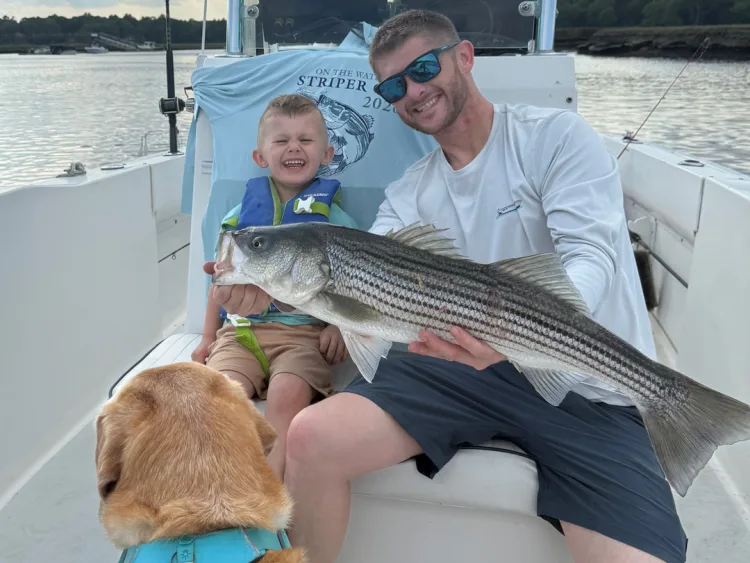
I have to credit my knowledge of this lure to surfcaster Dennis “DZ” Zambrotta and his tales of great success on Block Island. DZ would use the Red Fin as a sand eel imitator in the late 1970’s and early 1980’s, before the proliferation of needlefish-style plugs. Check out the article “Glory Days of Block Island” in the November 2008 issue of this magazine for a great photo of a well-used Red Fin that was responsible for a 61-pound bass in the early 1980’s. These plugs catch big fish!
What separates the Red Fin from the school of plastic swimmers on the market is its versatility and ability to be customized. Straight out of the package, the Red Fin is one of the best surface swimmers on the market, and when retrieved at a slow pace, it has a seductive wiggle and a ‘V’ wake that rivals the best Danny-style swimmer. In my experience, unmodified Red Fins work best in calm, shallow water, especially boulder fields, where they can swim over and around structure. A slow-and-steady retrieve always works best for me, but if you are getting short hits or follows, try a jerk-pause retrieve, pulling the lure a foot or two underwater and then allowing it to stop and float for a second or two. Oftentimes a cautious fish will crush the plug as it floats toward the surface.
If the breeze is in your face, or if extra casting distance is needed to reach the fish, it is time to modify the plug. Unweighted, a 7-inch Red Fin tips the scales at 1 ounce, but the hollow construction of the plug body allows you to add weight when needed. You can read about how to load a Cotton Cordell Pencil Popper in the article “Put Some Lead in Your Pencils” in the October 2008 issue of OTW; similar techniques can be applied to the Red Fin. While the author mentioned using lead shot to load his plugs, most Red Fin devotees use 10cc/10ml (or about 0.35 ounces) of water or another liquid. This amount of weight may seem trivial, but physics work in your favor here. When the plug is hanging vertically from your rod tip, water fills the tail-half of the plug body, which increases casting distance and reduces “tumble,” allowing for a more-streamlined cast. When the plug lands, the liquid redistributes into the belly section of the plug body, allowing it to swim effectively, albeit with a slightly dampened action. I know some anglers who use Red Fins loaded with 15cc of water, but these are for a specific application. When I tried it out, I found them to swim like a stick – 10cc seems to be the magic number! Just like with unweighted Red Fins, a slow and steady retrieve works best for me, but if you think there are fish around and you are not getting hits, try varying your retrieve until you find out what the fish want.
For colors, keep it simple. While the standard adage is to fish light colors in the daytime and on moonlit nights and to fish dark colors on dark nights, I think the natural color schemes are most effective. I prefer chrome with a blue or black back, or a “Smokey Joe,” which is a flat white with a dark gray back. After all, baitfish don’t change colors at night! Don’t be dismayed if the chrome starts to wear off, as they actually seem to fish better with age and abuse, and you can touch them up with spray paint at any time. The 7-inch Red Fin comes in seven standard colors, and some retailers have custom colors available, with ‘blurple’ (black over purple) all the rage on dark nights and ‘chicken-scratch’ (yellow and white with black marks) popular during the day and on moonlit nights. If you see some of these colors at your favorite retailer, snap a few up!
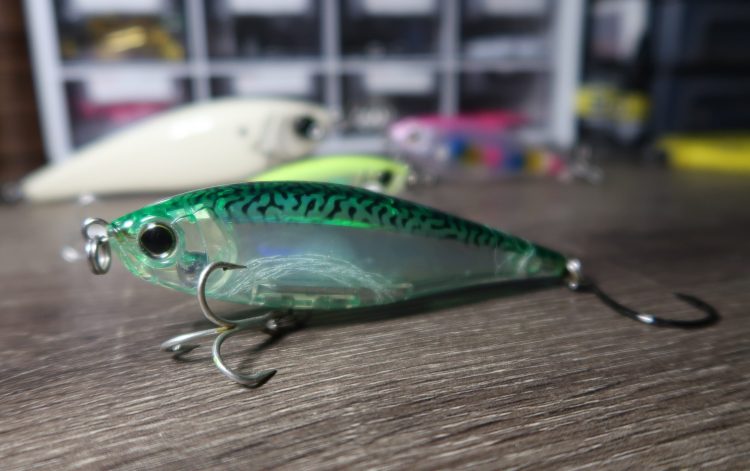
The last modification I recommend is to swap out the factory hooks and split rings and replace them with size 3/0 4X VMC treble hooks hanging from heavy-duty stainless-steel split rings. If there are any large bass or bluefish in the neighborhood, you will soon know, and you’ll want every advantage to hook and land them.
This spring, when you are walking the aisles of a tackle show or shop and stocking your plug bag with the latest and greatest in wooden lures, leave a few slots open for the “overlooked” plug.
Lure Archive
Point Jude Cobra •Salty's Sandeel Needle • RockOn Squid RiG
Rebel Pop-R • Little Cleo • Rattlin' rogue • Yo-Zuri Sashimi Minnow
DOA Shrimp •Tattoo's Walking Stick • Mepps Aglia Spinner
Surface Tension • Jitter Bug
|