

The bass came over the rail with all the fury of an unrestrained she devil hell bent on exacting revenge. If you consider that an exaggeration, it’s probably because you’ve never hooked up to a jumbo with a grudge to settle.
It was dark, wet, and slippery, and when Artie dropped the fish on the deck, I bolted to the top of the motor box while my deck mate searched for the billy to calm the green-eyed striper slashing around in the cockpit with three big trebles and nine razor-sharp barbs, looking for a place to stick them. My motor box was constructed of marine plywood with solid oak corners, and that bass buried a set of trebles into the oak past the barb.
An underachieving charter skipper who couldn’t catch a fish on a plug had been bad mouthing the Goo-Goo plugs, which he claimed couldn’t hold on to a hefty bass because the screw eyes would pull out. He didn’t have to use his pliers to worry that treble out of the oak, and he didn’t have the opportunity to inform Captain Frank Sabatowski that those plugs wouldn’t hold up under the stress and strain of a Massachusetts record 73-pound striper. On that fateful night of June 16, 1967, Charlie Cinto was lucky that his record fish attacked a lure that was up to the test of rips, rocks and boulders.
Leo Cooper’s Goo-Goo Eyes plugs were around when I began trolling the rips on Sow and Pigs off Cuttyhunk, Massachusetts, but I was never fortunate enough to snap one onto the end of my line. At that time I was using giant Creek Chub Pikes that I trolled along that rip and up and down the backside of the Elizabeth Islands from Southwest Bluff to Tarpaulin Cove. Those big Pikes were also a guide favorite and one of my most deadly eel-skin plugs. We had to replace the hooks quite often because we stored them in corrosive salt brine to keep the eel skins moist and scented, as well as to offset the outsized striper’s penchant for scrubbing and bending them in their rugged habitat.
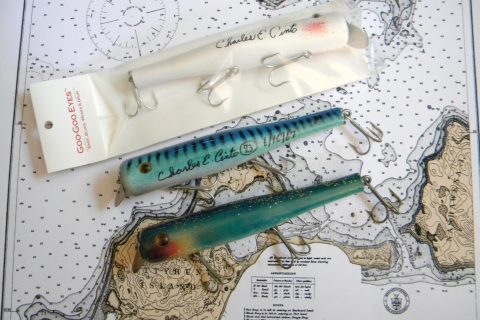
Cinto’s fish was caught on a blue-and-white Big Daddy Goo-Goo Eyes with yellow glass eyes and silver spackles along the topsides. Back then there weren’t anywhere near as many options as there are today, and that was a good thing. Guides swore their patrons to secrecy – even though most of them were using the same lures to tempt the goliath-sized stripers that foraged along the rip out to the Dry Pigs. At the time, the Creek Chub, Goo-Goo, Atom and the Russell lures were the principal lures, and one late afternoon while touring the guides’ dock while waiting for a tide I glanced into Captain Bob Smith’s shack where he was busy whittling a notch around the neck of a Goo-Goo Eyes Big Daddy in order to enhance his chances by slipping a monster eel skin over that offering.
Leo Cooper of Stamford, Connecticut was the designer and creator of the Goo-Goo Eyes plug. Cooper was a highly skilled tool and die maker who was also an inveterate inventor, so it was only natural that the Goo-Goo Eyes plug was a lure born out of necessity. Cooper routinely prowled the beaches of Long Island Sound in his successful quest for outsized stripers but could not find plugs big enough to suit his taste, so he designed one. His namesake plug was created in his basement workshop and his friend Art Glowka, a talented writer and fisherman and the co-founder of the Hudson River Foundation, looked on approvingly. Glowka was employed as an Eastern Airline pilot who discovered the signature glass teddy bear eyes during a trip to Hong Kong. Cooper immediately integrated the eyes into his creation and a deadly big bass plug was born.

After he and Glowka had field tested the plugs (Glowka caught a 52-pound bass from the Long Island shore with a prototype Goo-Goo) he decided to market them, and during that promotion he convinced Captain Frank Sabatowski of the charter boat June Bug in New Bedford to fish his lures. That connection paid off in diamonds on that fateful June night in 1967 that parlayed his creation into one of the hottest striper lures on the East Coast.

Once the story about Cinto’s 73 hit the newsstands, demand for Cooper’s lures skyrocketed, so Leo hired a man to work full time producing his lures. The winter of 1968 was the season of the Goo-Goo Eyes plug tour, as Cinto and Captain Frank headed for the boat show circuit with the 73-pounder mounted by the gifted taxidermist Wally Brown bundled in blankets and strapped to the roof of their car. Cinto and Sabby would get out of work on a Friday, load up the state-record fish and head for Cooper’s Connecticut home. They would work as many as two shows and numerous club appearances in a weekend and drive all night to get back home and get to work on Monday morning. Cinto has many fond memories of those winters and the friendship that developed between the three men that destiny and a heavyweight striper brought together.
To the best of Glowka’s knowledge, Cooper began building his plugs for personal use sometime between 1956 and 1958, and being the perfectionist he was, they were tweaked and turned until they were just what he wanted. As word of the plug’s success spread, he began to sell them and finally delivered a batch of plugs to Sabatowski. The rest is striped bass history.
Rick Mandile began fishing the Massachusetts South Shore as a teenager with Goo-Goo Eyes plugs in the early 1980s. When he moved to Westport, Massachusetts after college and started running charters around Cuttyhunk, Goo-Goo Eyes were no longer being manufactured so he tried to make his own. He made the tough decision to dissect one of his precious remaining few so he could and copy the construction and build them exactly like Cooper did. Since he was not changing anything significant to Leo’s elegantly simple plug design, he secured the trademark rights to Goo-Goo Eyes in 1998 and began offering the plugs to a few southern New England tackle stores under the name Cuttyhunk Tackle. Between business and family, Mandile was never able to devote his full attention to selling the plugs, so in the winter of 2011 he turned the business over to his friend Dan Smalley of Gibbs with the understanding that the Goo-Goo they produced would be an exact replica in every aspect, including the screw eyes and unique attachment of the swim lip.
For nearly 70 years, Gibbs Lures has been the New England standard for wooden plugs, so when Dan Smalley and Dennis Ryan purchased the company in 1999, they decided that they would maintain the tradition that Stan Gibbs initiated when he began turning out his iconic Gibbs popper. That simple lure fashioned from a wooden dowel was designed to tempt surface-feeding bass in the Cape Cod Canal during the mid 1940s, and it worked to perfection. That efficient plug launched the now celebrated practice of fooling stripers with hand-crafted wooden lures. The Gibbs team has walked a fine line between maintaining the quality and tradition of their line while conservatively updating and upgrading materials and finishes to provide fishermen with performance and value for their hard-earned dollars.
Sales manager Matt Smalley is upbeat about their acquisition on the Goo-Goo line and he invited Charlie Cinto to work their booth at the RISAA Salt Water fishing show in Providence, Rhode Island, where Cinto signed plugs and talked with fishermen about the history and prowess of the Goo-Goo Eyes Big Daddy that fooled his Massachusetts state record 73-pound striper. Cinto put one of the Gibbs prototype Big Daddy’s in my hand, which I compared alongside the prized original Goo-Goo he signed for me many years ago that commemorates that historic 1967 catch at Cuttyhunk. Although my prototype has not yet tasted saltwater, I believe it will swim just like the originals we have enjoyed so much success casting and trolling over these many seasons.
The Goo-Goo Eyes are being made in the original two sizes, which are the 8 ½-inch Big Daddy and the 3.25-ounce Junior. The plugs are being sealed and painted in the traditional colors as well as blue, yellow, silver, green, all white and black, and will be in tackle shops by the time this issue is on newsstand.